Tuesday, December 13, 2011
Monday, December 12, 2011
More on Lean from Michigan
I want to add a couple of more items to the post below about John Billi's MIT-sponsored webinar about Lean at the University of Michigan Health System.
When the Lean approach was first adopted at UMHS, there were some notable successes which I would term "projects." For example, a rapid improvement event was held to redesign the carts used for blood draws, using the 5S approach that I have often referenced on this blog. Here's the "before" view:
And here's the "after" view:
This is all good stuff, but it is not a full-fledged implementation of an organizational philosophy. What UMHS found out is that the cultural change inherent in Lean takes a long time to become embedded in the firm. At BIDMC, we used to talk about "tortoise not hare" when we described that. In essence, the process of adopting Lean becomes a Lean process itself. It is one of modesty and constant learning. Look, for example, at what John presented for the coming agenda for his institution.
The other point John made is when a map is constructed to enable all to all aspects of the value stream, "it's not the map that's valuable. It the process of mapping, which produces a shared understanding of the value stream and which enables the front-line team to design improvement experiments together."
Lean progress at the University of Michigan
I just listened to an extraordinarily well done webinar from MIT, presented by Dr. John E. Billi, associate dean for clinical affairs at the University of Michigan Medical School and associate vice president for medical affairs at the University of Michigan. John leads the Michigan Quality System, the University of Michigan Health System’s business strategy to transform clinical, academic, and administrative functions through development and deployment of a uniform quality improvement philosophy.
As noted in the webinar summary, the University of Michigan Health System (UMHS) has been on the lean journey for the past six years, creating the Michigan Quality System. UMHS has 20,000 faculty, staff, and trainees. The goal is to create 20,000 problem solvers who are finding and fixing root causes of problems they face daily. Dr. Billi described UMHS’ initial approach, results of early experiments, what leaders learned, and how they adjusted. The discussion covered the transition from scattered projects led by coaches to an integrated approach that incorporates people development and process improvement.
John's presentation was one of the best I have heard on this topic. His slides, too, were clear and descriptive. I'd like to show you all of them, but let me pick a few. The thing I liked best was the modesty and transparency demonstrated. Even after years of doing this work, John felt comfortable starting with this slide, showing where is system still needs work:
That he would feel the need to do so is even more striking when you look at some of the successes. Here are some results from cardiac surgery:
I liked the story about increasing mobility of ICU patients. Here's the summary chart:
But even better than the substantive results was the fact the Lean approach resulted in pull-based authority. Having achieved a broad consensus on objectives and experiments, the front-line team was able to exercise their discretion in how to carry out the improvement. You see them here accompanied by the grandson of a patient, another key participant.
John summarized other key lessons. The first is about how authority must devolve to make Lean work. "Leaders have to show respect, which means trusting people to solve their own problems if they are given the tools."
Finally, to reach the goal of having 20,000 problem solvers, you need to design brilliant processes, based on creating standard work.
I have some more observations in the post above.
I didn't mean it, HAL.
HAL: Look Dave, I can see you're really upset about this. I honestly think you ought to sit down calmly, take a stress pill, and think things over.
I remain impressed with the tendency of the health care industry and those new ventures who hope to sell to that industry to invent high-tech, high-cost approaches to problems that can be solved for much less money. Take this new robot described in a Boston Globe article by Jay Fitzgerald. Here's the lede:
When Erin Tally took Aidan, her 2-year-old son, home from Children’s Hospital Boston on the day after his urinary surgery, she brought along a new friend: a 4-foot-6, 17-pound, two-wheeled robot that would help deliver care to her recovering child.
Over about two weeks that included five video consultations, the robot, made by Vgo Communications Inc., of Nashua, eliminated the need for Tally to drive Aidan into Boston every three days for post-surgical checkups.
![]() |
| Photo by Bill Greene, Boston Globe Staff |
With cameras, advanced audio gear, and a video screen on its “face,’’ the robot allowed Aidan and his parents to talk with nurses and doctors in Boston. They could see and communicate with Aidan and his parents, take close-up photos of his surgical scars for doctors to review, and help determine what type of medications he needed.
Let's acknowledge that it would be inconvenient for a parent to drive the child in for follow-up appointments and could be a discomfort to the child. Is there another, less-expensive way to use technology to "see and communicate with Aidan and his parents, take close-up photos of his surgical scars for doctors to review, and help determine what type of medications he needed?"
I think so. The devices that could be used include a telephone, email or secure patient site, Skype or FaceTime, a camera, and/or an iPhone or other like device. Why spend $6,000 on a robot and more money for 4G service when the elements of a solution already exist? And please don't tell me that the answer is HIPAA.
Uh oh, have I now annoyed the robot???
----
** Headline source -- 2001, A Space Odyssey:
Dave Bowman: Hello, HAL. Do you read me, HAL?
HAL: Affirmative, Dave. I read you.
Dave Bowman: Open the pod bay doors, HAL.
HAL: I'm sorry, Dave. I'm afraid I can't do that.
Dave Bowman: What's the problem?
HAL: I think you know what the problem is just as well as I do.
Dave Bowman: What are you talking about, HAL?
HAL: This mission is too important for me to allow you to jeopardize it.
Dave Bowman: I don't know what you're talking about, HAL.
HAL: I know that you and Frank were planning to disconnect me, and I'm afraid that's something I cannot allow to happen.
Dave Bowman[feigning ingorance]: Where the hell did you get that idea, HAL?
HAL: Dave, although you took very thorough precautions in the pod against my hearing you, I could see your lips move.
Dave Bowman: All right, HAL. I'll go in through the emergency airlock.
HAL: Without your space helmet, Dave? You're going to find that rather difficult.
Dave Bowman: HAL, I won't argue with you anymore! Open the doors!
HAL: Dave, this conversation can serve no purpose anymore. Goodbye.
HAL: Affirmative, Dave. I read you.
Dave Bowman: Open the pod bay doors, HAL.
HAL: I'm sorry, Dave. I'm afraid I can't do that.
Dave Bowman: What's the problem?
HAL: I think you know what the problem is just as well as I do.
Dave Bowman: What are you talking about, HAL?
HAL: This mission is too important for me to allow you to jeopardize it.
Dave Bowman: I don't know what you're talking about, HAL.
HAL: I know that you and Frank were planning to disconnect me, and I'm afraid that's something I cannot allow to happen.
Dave Bowman[feigning ingorance]: Where the hell did you get that idea, HAL?
HAL: Dave, although you took very thorough precautions in the pod against my hearing you, I could see your lips move.
Dave Bowman: All right, HAL. I'll go in through the emergency airlock.
HAL: Without your space helmet, Dave? You're going to find that rather difficult.
Dave Bowman: HAL, I won't argue with you anymore! Open the doors!
HAL: Dave, this conversation can serve no purpose anymore. Goodbye.
Taylor's thinking clearly on health care
#IHI Hey, check out this new and thoughtful blog, Clear Thinking on Health Care, by a young man named Taylor Christensen. We met at the IHI Annual National Forum. He notes:
I am now in medical school, where I am doing an M.D./Ph.D. in Health Care Organization, Outcomes, and Policy. From there, I’ll be a physician/business strategist/health policist–my dream job! And my career goals are (1) to be an amazing physician and (2) to fix the health system, probably in that order.
Sunday, December 11, 2011
Andy, we hardly knew ya
When Andy Rooney died a while back, I wondered. Now, thanks to William Heisel, at Reporting on Health, for spreading the word about a piece written by Pat Mastors (seen here.) It is written in the style that might have been used by Mr. Rooney, himself. Here's her lede:
I died last week, just a month after I said goodbye to you all from this very desk. I had a long and happy life - well, as happy as a cranky old guy could ever be. 92. Not bad. And gotta say, seeing my Margie, and Walter, and all my old friends again is great.
But then I read what killed me: “serious complications following minor surgery.”
Now what the heck is that?
Indeed.
I died last week, just a month after I said goodbye to you all from this very desk. I had a long and happy life - well, as happy as a cranky old guy could ever be. 92. Not bad. And gotta say, seeing my Margie, and Walter, and all my old friends again is great.
But then I read what killed me: “serious complications following minor surgery.”
Now what the heck is that?
Indeed.
Saturday, December 10, 2011
The Inheritance of Loss
I just read The Inheritance of Loss by Kiran Desai (Grove Press, NY 2006), and felt great appreciation and not a little envy at her ability to write descriptively. I recommend it highly. The story takes place in West Bengal near the Himalayas. Here is a sample from pages 278-279:
She passed by fields and small clusters of houses, became confused in a capillary web of paths that crisscrossed the mountains, perpendicular as creepers, dividing and petering into more paths leading to huts perched along eyebrow-width ledges in the thick bamboo. Tin roofs promised tetanus; outhouses gestured into the ether so that droppings would fall into the valley. Bamboo cleaved in half carried water to patches of corn and pumpkin, and wormlike tubes attached to pumps led from a stream to the shacks. They looked pretty in the sun, these little homes, babies crawling about with bottoms red through pants with the behinds cut so they could do their susu and potty; fuchsia and roses -- for everyone in Kalimpong loved flowers and even amid botanical profusion added to it. Sai knew that once the day failed, through, you wouldn't be able to ignore the poverty, and it would become obvious that in these homes it was cramped and wet, the smoke thick enough to choke you, the inhabitants eating meagerly in the candlelight too dim to see by, rats and snakes in the rafters fighting over insects and birds' eggs. You knew that rain collected down below and made the earth floor muddy, that all the men drank too much, reality skidding into nightmare, brawls, and beating.
Friday, December 09, 2011
When is a protocol not a protocol?
Answer: When people don't follow it? Better answer: When people don't think they should follow it? Still better answer: When people don't follow it and people are harmed.
Lola Butcher (could we have picked a better teaser of a last name?) writes in Hospital and Health Networks that, according to the head of The Joint Commission, "surgeries on the wrong side of the body, the wrong site or even the wrong patient continue to occur an estimated 40 times every week." She notes that the JC "first highlighted the problem of wrong-site surgery in 1998." Further:
The Joint Commission already requires accredited hospitals and surgery facilities to use a universal protocol that covers preoperative verification, marking of the surgical site and taking a time-out by all members of the surgical team immediately before the procedure begins. The extent to which the protocol is followed varies widely.
While things sounds like a prima facie case of failure on the part of the accreditation body, it is more than that. The clinical director of the Pennsylvania Safety Authority notes that there have been some successes in the country, but:
"When you subtract out the 50 facilities that have been in those collaborations, we don't see any change at all in the remaining facilities," Clarke says. "We do think we have made a difference, but it's only when hospitals actually make a commitment to change their systems.""
The simple truth is that many doctors don't buy in to this. I've heard of some anesthesia writings that cite the statistics indicating the errors continue as evidence that the checklist protocol does not work! These observers completely ignored whether the protocol was actually being followed or not.
Let's go back to The Joint Commission. As I have discussed, failure to pay for such "never" events is not effective. While I am not keen on regulatory interventions, it is possible to use a light, but effective hand that could make a difference. How about starting by publicizing all cases on the public JC website, with the name of the hospital? Keep them in the public eye until a root cause analysis has been done and a remediation plan put in place. Then, share those success stories widely, as opposed to hiding them behind the JC paywall.
If that approach doesn't start to get results, adopt a policy of putting the hospital on probation, in terms of its accreditation, until a root cause analysis has been done and a remediation plan put in place.
This is what dominance looks like
Sometimes, as they say, a picture is worth a thousand words. This is a chart from a recent investor presentation showing the market share of the dominant provider group in Massachusetts.
As I have said before, this represents excellent execution of a business strategy formulated in the mid-90s, when this system was founded by a corporate affiliation of Brigham and Women's Hospital and MGH. It has resulted in a behemoth, and the state's largest insurer has said publicly that it does not have the ability to withstand the resultant market power -- and acts that way, too.
The chart shows only tertiary discharges, reflecting the 4,000 licensed beds and 6,560 physicians in this system, with operating revenues of $8.5 billion in fiscal year 2011. So, when you read a story about this system being vulnerable to the poaching of a 90-doctor group by a cash-laden private equity firm, you really have to wonder. Especially when the story notes: "Compass doctors send many of their patients to the Brigham for advanced care, and doctors intend to continue that relationship."
How convenient, though, for the dominant player when such an event happens. It can spin the story and assert that this shows how market forces are at work.
In other regions characterized by similar market dominance (e.g., Utah with Intermountain Health; parts of Wisconsin with Gundersen Lutheran, parts of Pennsylvania with Geisinger), the local provider systems have demonstrated an agenda of controlling the growth of health care costs by focusing on improving quality and safety and process improvement. This Massachusetts system could have and still could exercise similar leadership, but not if it continues to execute the old growth model.
Thursday, December 08, 2011
Private equity buys the human resource equity
A story in today's Boston Globe again misconstrues the business plan of Steward Health Care System in acquiring a physician group that was part of the Partners Healthcare System.
Compass Medical includes 90 doctors in eight offices between Braintree and Taunton, and over time, doctors there probably will refer more of their thousands of patients to nearby Steward-owned community hospitals for care, including Quincy Medical Center, Good Samaritan Medical Center in Brockton, and Morton Hospital in Taunton.
The change is a loss for Partners, a powerful provider network that includes Massachusetts General and Brigham and Women’s hospitals, which has been affiliated with Compass for 16 years.
The Steward plan does not divert patients from PHS hospitals. If anything, it is an attempt to divert them from the other community hospitals in those regions, like Milton and Brockton Hospital. PHS does not have community hospitals in that region. Remember, too, that Steward is using MGH as its tertiary center.
This whole thing, though, is really part of the usual private equity strategy during the years leading up to an IPO or other flip of the Steward network. The name of the game is to show investors a pattern of market share and revenue growth. The profitability of such moves is secondary, in the investment world, to an increase in scale. When viewed that way, it doesn't matter what Steward pays to acquire these physician groups for just a few years: There is no way, though, that the incumbents can match the acquisition price, as they have to plan to stay in business for years to come.
Something we'd rather not need
Imperial College in London has opened up a new research center to assess the effects of roadside bombs on British troops. The Royal British Legion is providing £5 million to establish the center. As noted in this article in the International Business Times:
The Royal British Legion Centre for Blast Injury Studies at Imperial College will plan the new tools that will develop better ways of protecting British troops.
"The Centre for Blast Injury Studies aims to improve treatment and recovery for those injured serving their country, as well as to reduce the number and extent of blast injuries in the first place," Chris Simpkins, Director General, The Royal British Legion, said in a statement.
This is an excellent idea. One of the often untold stories of these wars is the resulting long-term damage to soldiers who are in vehicles. Even when they are not maimed physically, they can often suffer brain damage from the concussive effects of these explosions. There are many soldier who return with live-long migraine headaches, for example. They are forced to live a life of heavy medication and disability.
The Times story continues:
"We now need to assess the effects of blasts on survivors. We urgently need to know more, so that we can protect and treat people more effectively. This Centre can make a real difference to the survival and quality of life of those serving in conflicts," Anthony Bull, Professor at Department of Bioengineering at Imperial College, said.
Exactly.
Wednesday, December 07, 2011
Brilliant or anachronistic?
I write this not as a competitor, for that is no longer the case. Neither do I write this with some Machiavellian purpose to support my former hospital. I write it as a citizen watching the unfolding of a business plan that seems to me to be building in future health care cost increases for our region, or worse, potentially weakening one of the country’s great hospitals.
I refer to the exposition by Robert Weisman in the Boston Globe of expansion plans for Brigham and Women’s Hospital. The plan is to build roughly $500 million in clinical and research space over the next few years. It is hard to see how this much new clinical space can yield a positive return, given the pending environment of constrained payment rates from governmental and private payers. Indeed, the last major clinical addition to that hospital reportedly failed to show a positive return in the financial projections used at the time, and that was several years ago.
It is even more hard to see how additional research space would yield a positive return, given a likely flattening of NIH funding and given that research funds never fully compensate a hospital for the indirect costs associated with those laboratories.
When I read that the program was the result of consultation with hundreds of people in the hospital, it made me wonder whether it is partly a compendium of the wish-lists of different constituencies in the organization. How much rigorous analysis went into this, versus the kind of territorial expansion that usually characterizes strong-willed people in an academic medical center?
As I have noted before -- and as Clay Christensen puts so forth so clearly in The Innovator’s Prescription -- the business model of general hospitals is already at risk. Even more so for academic medical centers. The name of the game for the future must be to minimize new capital commitments and their concomitant fixed cost additions, while focusing on Lean or other process improvement approaches to reduce waste, inefficiency, and patient harm.
It is hard for me to see how the plan laid out in the Globe makes sense. It is either so brilliant that I cannot understand its basis, or so out of touch as to be an anachronism.
I refer to the exposition by Robert Weisman in the Boston Globe of expansion plans for Brigham and Women’s Hospital. The plan is to build roughly $500 million in clinical and research space over the next few years. It is hard to see how this much new clinical space can yield a positive return, given the pending environment of constrained payment rates from governmental and private payers. Indeed, the last major clinical addition to that hospital reportedly failed to show a positive return in the financial projections used at the time, and that was several years ago.
It is even more hard to see how additional research space would yield a positive return, given a likely flattening of NIH funding and given that research funds never fully compensate a hospital for the indirect costs associated with those laboratories.
When I read that the program was the result of consultation with hundreds of people in the hospital, it made me wonder whether it is partly a compendium of the wish-lists of different constituencies in the organization. How much rigorous analysis went into this, versus the kind of territorial expansion that usually characterizes strong-willed people in an academic medical center?
As I have noted before -- and as Clay Christensen puts so forth so clearly in The Innovator’s Prescription -- the business model of general hospitals is already at risk. Even more so for academic medical centers. The name of the game for the future must be to minimize new capital commitments and their concomitant fixed cost additions, while focusing on Lean or other process improvement approaches to reduce waste, inefficiency, and patient harm.
It is hard for me to see how the plan laid out in the Globe makes sense. It is either so brilliant that I cannot understand its basis, or so out of touch as to be an anachronism.
A final toast to #IHI
Just when I thought it was safe to eat the oatmeal, I discovered problems with the bagels! Readers from last year's IHI National Forum may recall my series of articles about the non-Lean system used to serve oatmeal at the conference facility. That was a four-part series. And remember, too, this Lean conference in Springfield, MA, where they had a problem serving the toast.
So, now, look at this set-up. I first saw the potential for a problem when I came downstairs and noticed a really, really large number of bagels and one four-slice toaster per station. I guessed that this would create backlogs.
And, voila! When the people came to eat, sure enough. Not enough toasters for the flow of traffic. We had introduced a blocking batch process in what should have been a cleaner continuous process. This creates waste, in the form of unnecessary time spent.
One of the hotel staff people saw me taking the pictures, and we started joking about the problem. S/he said, "We used to have another toaster at each station, but the electrical circuitry in each socket got overloaded, so we had to remove one. This back-up always happens."
This demonstrates that in a facility, Lean starts in the design. The architect and electrical planner for this conference center did not have a full understanding of how the building would be used. Waste built in is waste that lasts forever. Another lesson to those in health care.
So, now, look at this set-up. I first saw the potential for a problem when I came downstairs and noticed a really, really large number of bagels and one four-slice toaster per station. I guessed that this would create backlogs.
And, voila! When the people came to eat, sure enough. Not enough toasters for the flow of traffic. We had introduced a blocking batch process in what should have been a cleaner continuous process. This creates waste, in the form of unnecessary time spent.
One of the hotel staff people saw me taking the pictures, and we started joking about the problem. S/he said, "We used to have another toaster at each station, but the electrical circuitry in each socket got overloaded, so we had to remove one. This back-up always happens."
This demonstrates that in a facility, Lean starts in the design. The architect and electrical planner for this conference center did not have a full understanding of how the building would be used. Waste built in is waste that lasts forever. Another lesson to those in health care.
Cooley Dickinson KOs C. diff
#IHI Cooley-Dickinson Hospital in Northhampton, MA, has had an exemplary record for infection control, knocking out central line infections for an extended period, but they have just reached some new heights. They used a high intensity, pulsing ultraviolet light to kill Clostridium difficile and MRSA (methicillin-resistant Staphylococcus aureus) bugs in patient rooms and elsewhere. C. diff, a bacteria that can cause diarrhea and when severe can cause sepsis and death, is a difficult organism to kill: Its spores lay dormant but potent on surfaces of patient rooms (e.g., walls and bed rails). Bleach is the most effective cleaning agent, but it is hard to know if all areas have been properly cleaned.
The technique is to use the Xenex system to have 120 flashes per minute for seven minutes in each patient room, and each bathroom, and each OR after discharge and each emergency department space every day. This was all added to aggressive previous approaches like MRSA screening before admitting patients, and using precautions.
During the application period, the UV light bounces all over the room, on all surfaces and into cracks that might otherwise be missed. The results were extraordinary:
Or to put it in the technical terms of a recent poster presented by Joanne Levin, MD; Linda Riley, RN; Christine Parrish, RN; and Daniel English:
Methods. During January 2011, the use of two PPX-UV devices to disinfect patient rooms was phased in. Rooms and bathrooms were terminally cleaned as usual with a chlorine- based product, followed by the use of PPX-UV, usually for three, seven-minute exposures (once in the bathroom, twice in the bedroom). The overall room turnover time was extended by about 15 minutes. When a device was not being used for terminal cleaning of patient rooms, it was also used in the operating suites, emergency department, and other areas. Surveillance for HA-CDI using SHEA definitions continued as per routine. No other new infection prevention interventions were instituted during this time.
Results: CDI cases were found for a rate of 3.18/10,000 patient days (pd). This compares favorably with the rate of 9.5/10,000 pd for all of 2010. We also compared Q1-Q3 data for the previous three years. The combined Q1-Q3 rate for 2008-2010 was 9.77/10,000 pd compared to 3.18 for Q1-Q3 2011 when PPX-UV was used, resulting in a 67% decline (p=0.017). In addition, to date there have been no HA-CDI–related deaths or colectomies since the institution of PPX-UV.
I wonder if this will become the disinfection routine of choice over time.
The technique is to use the Xenex system to have 120 flashes per minute for seven minutes in each patient room, and each bathroom, and each OR after discharge and each emergency department space every day. This was all added to aggressive previous approaches like MRSA screening before admitting patients, and using precautions.
During the application period, the UV light bounces all over the room, on all surfaces and into cracks that might otherwise be missed. The results were extraordinary:
Or to put it in the technical terms of a recent poster presented by Joanne Levin, MD; Linda Riley, RN; Christine Parrish, RN; and Daniel English:
Methods. During January 2011, the use of two PPX-UV devices to disinfect patient rooms was phased in. Rooms and bathrooms were terminally cleaned as usual with a chlorine- based product, followed by the use of PPX-UV, usually for three, seven-minute exposures (once in the bathroom, twice in the bedroom). The overall room turnover time was extended by about 15 minutes. When a device was not being used for terminal cleaning of patient rooms, it was also used in the operating suites, emergency department, and other areas. Surveillance for HA-CDI using SHEA definitions continued as per routine. No other new infection prevention interventions were instituted during this time.
Results: CDI cases were found for a rate of 3.18/10,000 patient days (pd). This compares favorably with the rate of 9.5/10,000 pd for all of 2010. We also compared Q1-Q3 data for the previous three years. The combined Q1-Q3 rate for 2008-2010 was 9.77/10,000 pd compared to 3.18 for Q1-Q3 2011 when PPX-UV was used, resulting in a 67% decline (p=0.017). In addition, to date there have been no HA-CDI–related deaths or colectomies since the institution of PPX-UV.
I wonder if this will become the disinfection routine of choice over time.
Tuesday, December 06, 2011
Poster session at #IHI
Each years, dozens of people present posters at the IHI National Forum. Here's a sampling from today's presentations.
As you have seen, one of them is from Atrius Health, a Massachusetts multi-specialty practice. Here's a nice graphic showing attendance at the Leadership Academy discussed in the video.
If you cannot see the video, click here.
As you have seen, one of them is from Atrius Health, a Massachusetts multi-specialty practice. Here's a nice graphic showing attendance at the Leadership Academy discussed in the video.
If you cannot see the video, click here.
Scholtz and Wall at #IHI
You never know what you'll find wandering the halls during the IHI National Forum. I came upon this duo -- Bellingham's Richard Scholtz on the autoharp and Seattle's Eric Wall on the mandolin. They never have time to get together in Puget Sound, so Orlando became the venue of choice.
Here it is live and unedited, including Richard setting up his dinner time, and with a surprise appearance in the audience, Dartmouth health quality guru Paul Batalden.
If you cannot see the video, click here.
Here it is live and unedited, including Richard setting up his dinner time, and with a surprise appearance in the audience, Dartmouth health quality guru Paul Batalden.
If you cannot see the video, click here.
PACE -- Managed care for frail elders
#IHI I'm taking these notes as Jennie Chin Hansen, President of the American Geriatrics Society, leads a session at the IHI Annual National Forum on PACE, the Program for All-Inclusive Care, a comprehensive capitated program for "dual-eligible" Medicare/Medicaid patients.
The focus of this program is in on frail, disabled, complex elderly patients. There is a comprehensive offering of services on different sites (e.g., recreational therapy, nursing, physical therapy, meals, nutritional counseling, home health care, psychiatric care, social work, prescription drugs, social services, audiology, dentistry, podiatry, speech therapy, optometry, respite care.) As you can see, this relies on an interdisciplinary team, and they and the services follows the person on a 24x7 basis.
The first center was founded by a social worker and dentist in 1973. The concept spread, with the aim of spending equal or less than was being spent in nursing home facilities. In the early 1980s, the people doing this demonstrated a savings of 5% and were able to negotiate a dual-eligible contract with the state and federal governments, based on administrative waivers of the rules. Later, in 1997, there was bipartisan Congressional support to make the program permanent. (Hard to imagine today: It was a 13-0 vote in the Commerce Committee!) It took nine years, though, for the full rule-making process to be finished.
The program honors what frail elders want: To stay in familiar surroundings, to maintain autonomy, and to maintain a maximum level of physical, social, and cognitive function.
The components of the population (average age of 80) indicate the following complexity -- frailty, co-morbidity (six or seven conditions, on average), mobility impairment and disability cognitive impairment. Given this mix, there is an important focus on activities of daily living (ADL). Also, a goal is to avoid acute care episodes, in part to avoid hospital-acquired disability, as well as to avoid the cost of that type of care.
PACE eligibly: Age 55+; nursing home certified; PACE service area; Able to live safely in the community; must enroll all eligible applicants; 95% dually eligible.
Mean age is 80; 75% women; ADL deficits 3.5; 63% have cognitive impairment; average life expectancy in the program is 4.5 years.
PACE is small in scale. Nationally, there are only 23,000 participants served by 80 organizations in 23 states. There are 100-2000 participants per program.
A final and interesting note: The van drivers are the first line of information about the patients, as they can get see early warnings of problems.
The focus of this program is in on frail, disabled, complex elderly patients. There is a comprehensive offering of services on different sites (e.g., recreational therapy, nursing, physical therapy, meals, nutritional counseling, home health care, psychiatric care, social work, prescription drugs, social services, audiology, dentistry, podiatry, speech therapy, optometry, respite care.) As you can see, this relies on an interdisciplinary team, and they and the services follows the person on a 24x7 basis.
The first center was founded by a social worker and dentist in 1973. The concept spread, with the aim of spending equal or less than was being spent in nursing home facilities. In the early 1980s, the people doing this demonstrated a savings of 5% and were able to negotiate a dual-eligible contract with the state and federal governments, based on administrative waivers of the rules. Later, in 1997, there was bipartisan Congressional support to make the program permanent. (Hard to imagine today: It was a 13-0 vote in the Commerce Committee!) It took nine years, though, for the full rule-making process to be finished.
The program honors what frail elders want: To stay in familiar surroundings, to maintain autonomy, and to maintain a maximum level of physical, social, and cognitive function.
The components of the population (average age of 80) indicate the following complexity -- frailty, co-morbidity (six or seven conditions, on average), mobility impairment and disability cognitive impairment. Given this mix, there is an important focus on activities of daily living (ADL). Also, a goal is to avoid acute care episodes, in part to avoid hospital-acquired disability, as well as to avoid the cost of that type of care.
PACE eligibly: Age 55+; nursing home certified; PACE service area; Able to live safely in the community; must enroll all eligible applicants; 95% dually eligible.
Mean age is 80; 75% women; ADL deficits 3.5; 63% have cognitive impairment; average life expectancy in the program is 4.5 years.
PACE is small in scale. Nationally, there are only 23,000 participants served by 80 organizations in 23 states. There are 100-2000 participants per program.
A final and interesting note: The van drivers are the first line of information about the patients, as they can get see early warnings of problems.
Lessons for hospitals from the Gaylord Palms
#IHI Transforming health care will require, among other things, the enthusiastic engagement of staff throughout the nation's hospitals in process improvement. The means for doing this have been demonstrated by corporations in other sectors. Led by Eric Dickson, Senior Associate Dean of U. Mass. Memorial Hospital, and Christina Gunther-Murphy, IHI's Director of Hospital Portfolio Operations (seen here), a group of us at the IHI Annual National Forum had a chance to witness one such approach during an excursion at the Gaylor Palms hotel and resort.
In this all-day session, entitled "Joy in Work and Staff Best Practices," we were treated to a dynamic and informative presentation by Richard Caines, training manager at the Gaylord Palms. You see him here in the caricature portrait hanging outside the door of the human resources department. I choose this way to introduce Richard because it exemplifies an underlying premise of the GP approach, to create opportunities whenever possible to have fun in the workplace, with an example set by leaders throughout the company.
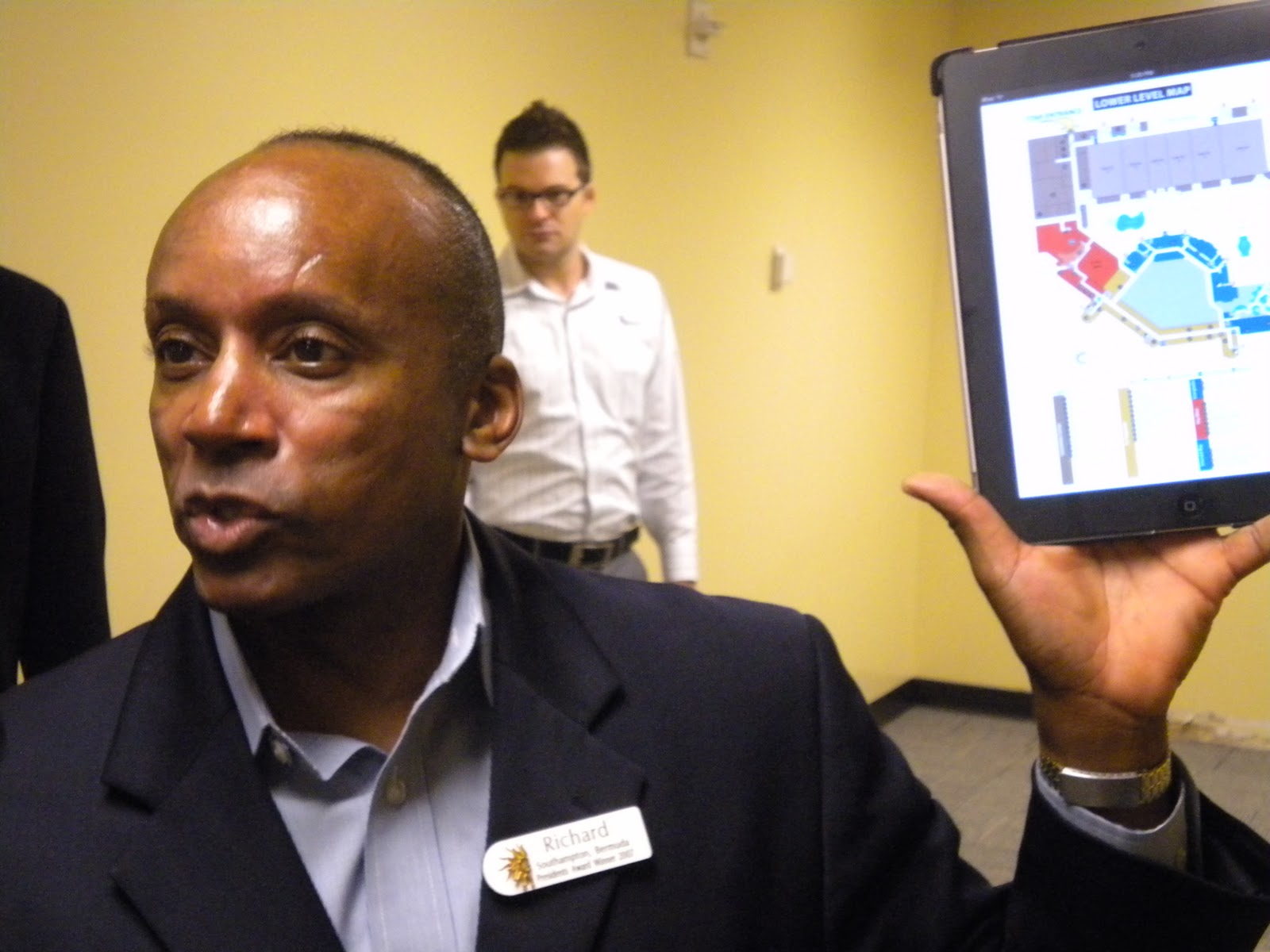
Richard, seen here in his real body, had a lot of serious things to say, too. The first related to the criteria used by the Gaylord Palms in hiring staff. Those "non-negotiable" attributes are laid out explicitly: Ability to Smile, engage in Team work, bringing the right Attitude to work, Reliability, and Serving with a passion. Staff, hereafter called STARS, are considered for employment in joint interviews, where HR professionals and line managers look to see which people in the session rise to the top compared to other applicants. For some jobs, 500 people might apply for a single positions. Here's Richard in a short video describing the attributes more fully. (If you cannot see the video click here.)
A thoughtful orientation has to follow a good hiring process. All STARS receive a full two-day orientation by Richard, focusing on corporate culture, goals, and the like. Each person then receives a personalized two-week orientation, after which he or she is fully capable of independently carrying out all the responsibilities of the assigned job. Ninety days later, an orientation reunion is held, at which each STAR has a chance to provide feedback to the company on the quality of the work experience and the environment, and on the orientation process itself.
But good hiring and even a good orientation do not make a good organization. It takes a corporate culture of trust, empowerment, assistance, and abetting personal and professional growth to deliver fine excellent service all the time to one another and to guests. Richard explained the panoply of programs offered by the Gaylord Palms to make life better for its STARS. This includes amenities like an on-site car repair shop, laundry service, convenience store, physical trainers and athletic facilities, and amazingly inexpensive ($1.50 per lunch) cafeteria.
There are more substantive human resource approaches at work, too. A bonus system provides, based on meeting guest satisfaction goals, offer all hourly STARS the chance for a monthly cash payout. Even when a staff member has poor performance, the first step in the progressive discipline process is counseling, to see what might be done to help a person regain his or her footing and begin to excel again. There are also clear moral and ethical standards, the "Red Rules," that make it clear that things like serving alcohol to a minor or hiring an illegal immigrant, will result in termination. (Even there, the first step by the supervisor is suspension: The actual termination process can only be carried out by the trained and designated HR professional.)
As part of the commitment to staff to provide the support and resources necessary to provide flawless service, there are also regular STARS satisfaction surveys. The last one had only one question. Staff were asked to give an answer from 1 to 5 on the following statement: "I am completely satisfied with my job." Later, in section meetings, staff are queried, "What makes this a great place?" and "What would make it a better place?" Is there any doubt why this is the only hotel consistently listed in the top 25 companies for working families by the local newspaper?
But a really fine organization depends on strong leaders who understand that their role is not to micromanage, but to coach. As noted above, at the Gaylord Palms, leaders also look for opportunities to create fun. They are expected to model the mutual respect that is a corporate standard. I close this post with another video of Richard explaining some of these aspects of the corporate culture -- and with the question for my colleagues in the hospital world, "What aspects of what we learned from Richard might be applied in our environment, one dedicated to high service to patients and families, and one dependent on the human capital in the organization to deliver that service?"
If you cannot see the video, click here.
In this all-day session, entitled "Joy in Work and Staff Best Practices," we were treated to a dynamic and informative presentation by Richard Caines, training manager at the Gaylord Palms. You see him here in the caricature portrait hanging outside the door of the human resources department. I choose this way to introduce Richard because it exemplifies an underlying premise of the GP approach, to create opportunities whenever possible to have fun in the workplace, with an example set by leaders throughout the company.
Richard, seen here in his real body, had a lot of serious things to say, too. The first related to the criteria used by the Gaylord Palms in hiring staff. Those "non-negotiable" attributes are laid out explicitly: Ability to Smile, engage in Team work, bringing the right Attitude to work, Reliability, and Serving with a passion. Staff, hereafter called STARS, are considered for employment in joint interviews, where HR professionals and line managers look to see which people in the session rise to the top compared to other applicants. For some jobs, 500 people might apply for a single positions. Here's Richard in a short video describing the attributes more fully. (If you cannot see the video click here.)
A thoughtful orientation has to follow a good hiring process. All STARS receive a full two-day orientation by Richard, focusing on corporate culture, goals, and the like. Each person then receives a personalized two-week orientation, after which he or she is fully capable of independently carrying out all the responsibilities of the assigned job. Ninety days later, an orientation reunion is held, at which each STAR has a chance to provide feedback to the company on the quality of the work experience and the environment, and on the orientation process itself.
But good hiring and even a good orientation do not make a good organization. It takes a corporate culture of trust, empowerment, assistance, and abetting personal and professional growth to deliver fine excellent service all the time to one another and to guests. Richard explained the panoply of programs offered by the Gaylord Palms to make life better for its STARS. This includes amenities like an on-site car repair shop, laundry service, convenience store, physical trainers and athletic facilities, and amazingly inexpensive ($1.50 per lunch) cafeteria.
There are more substantive human resource approaches at work, too. A bonus system provides, based on meeting guest satisfaction goals, offer all hourly STARS the chance for a monthly cash payout. Even when a staff member has poor performance, the first step in the progressive discipline process is counseling, to see what might be done to help a person regain his or her footing and begin to excel again. There are also clear moral and ethical standards, the "Red Rules," that make it clear that things like serving alcohol to a minor or hiring an illegal immigrant, will result in termination. (Even there, the first step by the supervisor is suspension: The actual termination process can only be carried out by the trained and designated HR professional.)
As part of the commitment to staff to provide the support and resources necessary to provide flawless service, there are also regular STARS satisfaction surveys. The last one had only one question. Staff were asked to give an answer from 1 to 5 on the following statement: "I am completely satisfied with my job." Later, in section meetings, staff are queried, "What makes this a great place?" and "What would make it a better place?" Is there any doubt why this is the only hotel consistently listed in the top 25 companies for working families by the local newspaper?
But a really fine organization depends on strong leaders who understand that their role is not to micromanage, but to coach. As noted above, at the Gaylord Palms, leaders also look for opportunities to create fun. They are expected to model the mutual respect that is a corporate standard. I close this post with another video of Richard explaining some of these aspects of the corporate culture -- and with the question for my colleagues in the hospital world, "What aspects of what we learned from Richard might be applied in our environment, one dedicated to high service to patients and families, and one dependent on the human capital in the organization to deliver that service?"
If you cannot see the video, click here.
Subscribe to:
Posts (Atom)